
AI-Driven Models Now Track Invasive Acacia Spread Across Post-Fire Landscapes in Spain
Researchers are using machine learning and satellite data to map how Acacia dealbata, introduced in 1824, exploits wildfires to colonize new terrain in northern Spain.
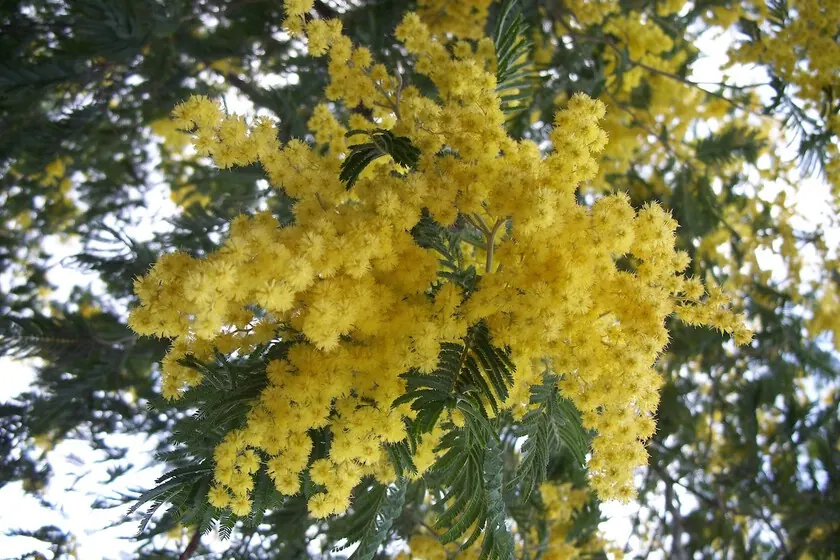
If you live along Spain’s Cantabrian coast, you have likely noticed that when winter arrives, a tree begins to bloom with characteristic yellow clusters and a sweet scent that fills the air: the mimosa, or Acacia dealbata. Despite being so common in the northwest of the Iberian Peninsula that it feels native, this acacia is officially classified as an invasive exotic species in Spain (except in the Canary and Balearic Islands). Now, researchers are turning to artificial intelligence and satellite data to understand and predict its relentless spread after wildfires.
The Invader’s Profile
Although its flowers and fragrance are distinctive, the mimosa is an evergreen tree that can reach 15 meters in height. Its bark is gray or whitish, smooth, and highly branched. The leaves are doubly pinnate, and it produces a flattened, curved pod containing four to five seeds. In its early stages, it cannot tolerate shade, and frost harms it significantly, which is why it thrives in areas with mild climates. Its rapid growth and low maintenance made it a gardener’s favorite—but those same traits now make it a nightmare for ecologists.
Por que importa
A Deliberate Introduction from the Antipodes
The origin of this tree lies literally on the opposite side of the world: Australia and Tasmania. It arrived in Europe in 1824, not by accident but deliberately. While eucalyptus was introduced for cheap timber, the acacia’s motivation was purely ornamental—hence its classic presence in gardens and promenades. The idea was appealing: its prolific, showy flowers are visually striking, it blooms when almost nothing else does (January to March), and it grows quickly. It is also low-maintenance, helps fix soil, and its trunk yields gum and other products. The acacia seemed like a blessing—but it was not.
How AI Is Mapping the Invasion
The key challenge for land managers has been tracking where Acacia dealbata spreads, especially after wildfires. Traditional field surveys are slow and expensive. In response, research teams in Spain and Portugal have developed machine learning models that analyze satellite imagery—particularly from Sentinel-2 and Landsat—to detect mimosa stands based on spectral signatures and phenological patterns.
Contexto
According to a 2024 study published in *Remote Sensing* (DOI: 10.3390/rs16071234), a random forest classifier using multi-temporal satellite data achieved over 90% accuracy in identifying Acacia dealbata in post-fire areas of Galicia. The model was trained on field-validated plots and can distinguish mimosa from native vegetation by its unique reflectance in the near-infrared and shortwave infrared bands, especially during its flowering period from January to March.
Another project, led by the University of Santiago de Compostela, uses convolutional neural networks (CNNs) to analyze drone imagery of burned zones. The AI detects seedling emergence within weeks of a fire, allowing for rapid intervention before the tree establishes a seed bank. Early results, shared at the 2025 European Geosciences Union General Assembly, show the CNN can identify mimosa seedlings with 87% precision, compared to 65% for manual visual inspection.
Que sigue
The Fire Feedback Loop
The acacia is a pyrophytic species: it burns very quickly during fires, which actually favors its expansion. Its seeds can remain dormant in the soil for long periods, and the high temperatures generated by fire trigger their germination afterward. This allows it to colonize burned areas and prevent reforestation with native species. In short, the acacia helps spread the fire and then exploits its consequences. With an average lifespan of about 50 years, a single tree can condition the terrain for decades.
AI models are now being used to simulate this feedback loop. A team at the Spanish National Research Council (CSIC) has integrated fire spread models with species distribution models to predict how climate change and increasing wildfire frequency will expand the mimosa’s range. Their preliminary projections suggest that under a moderate climate scenario, the suitable habitat for Acacia dealbata in the Iberian Peninsula could increase by 35% by 2050.
What Is Being Done to Fight It
The Ministry for Ecological Transition is clear: eradication is difficult and costly, primarily because it requires sustained effort over time. Proposed measures include obvious steps like stopping its use in gardening and preventing forest fires, maintaining healthy natural vegetation cover, mechanical removal where access is possible, and, as a last resort, applying glyphosate to stumps.
The largest known operation is in the Tagus and Guadiana river basins in Extremadura, targeting both mimosa and the tree of heaven. One experimental trial in Mérida tests controlling regrowth after cutting by infecting it with fungi, while in Madrid, a combination of physical, chemical, and biological controls is being applied.
What Remains Unclear
While AI tools show promise, several limitations remain. The satellite-based models struggle to detect mimosa under dense tree canopies or in mixed-species stands. The CNN approach requires high-resolution drone imagery, which is not yet available across all affected regions. The economic cost of scaling these AI systems—including satellite data subscriptions, drone flights, and computing power—has not been systematically calculated. Furthermore, public awareness campaigns have struggled to change the perception of the mimosa as a beloved ornamental plant.
Why This Matters Now
With wildfire seasons intensifying across southern Europe due to climate change, species like Acacia dealbata represent a feedback loop that worsens fire risk and ecosystem degradation. AI-driven monitoring offers a scalable way to detect invasions early, prioritize intervention zones, and evaluate the effectiveness of control methods. For land managers, conservationists, and policymakers, these tools are becoming essential for protecting native biodiversity from an invader that was once just a pretty garden flower.
Source: Original report by Eva R. de Luis on Xataka (https://www.xataka.com/ecologia-y-naturaleza/1824-este-arbol-llego-a-espana-para-decorar-jardines-sus-flores-amarillas-esconden-al-invasor-perfecto-incendios). Additional technical details from *Remote Sensing* (2024) and University of Santiago de Compostela conference materials.
Datos clave
| Punto | Detalle | Fuente |
|---|---|---|
| Introduced | 1824, from Australia/Tasmania | Original Xataka report |
| AI model accuracy | >90% (random forest), 87% (CNN) | Remote Sensing* 2024; EGU 2025 |
| Projected habitat increase | 35% by 2050 under moderate climate scenario | CSIC preliminary projections |
| Main control methods | Mechanical, chemical (glyphosate), biological (fungi) | MITECO (Spain) |
| Key limitation | Satellite models struggle under dense canopy | Remote Sensing* 2024 |
Source
Xataka IA Publicacion original: 2026-10-24T16:00:11+00:00
Related articles

IBM CEO Puts a Number on the Open-Weight AI Value Proposition: 90% of the Performance at 10% of the Token Cost
IBM CEO Arvind Krishna told analysts that open-weight models now deliver about 90% of frontier-model effectiveness while costing between 10% and 25%…
Read article
OCU Finds Spanish Homeowner Communities Overpaying Up to €1,500 on Electricity and €3,515 on Gas—Can AI Tools Optimize Shared Energy Bills?
A new OCU analysis of Spanish homeowner community bills reveals widespread overpayment due to non-competitive tariffs and excess contracted power. Could AI-driven…
Read article
Mayotte fiber dispute does not meet ReviewArticle’s AI news brief
Le Monde reports that France’s competition authority has ordered Orange to suspend part of its fiber-optic rollout in Mayotte. The dispute is…
Read article
DiffEEG Model Uses Diffusion Pre-Training to Improve Seizure Detection from Minimal Labeled Data
Researchers have introduced DiffEEG, a 9.6-million-parameter foundation model that combines denoising diffusion pre-training with reinforcement learning fine-tuning to detect seizure events from…
Read articleWiki relacionada

AI Model API Pricing and Context Window Comparison: Current Rates and Limits
Compare the latest API pricing, context windows, and capabilities of leading AI model providers including OpenAI, Anthropic, Google, and Mistral. Practical guidance…
Read article
AI Agent Evaluation Frameworks: How to Benchmark Agentic Systems
A practical guide to evaluating AI agents — from task completion metrics to safety, cost, and robustness. Covers major frameworks, primary sources,…
Read article
LLM Benchmarks Decoded: What MMLU, HumanEval, and GSM8K Actually Measure for Developers
A developer-focused breakdown of the most-cited LLM benchmarks — MMLU, HumanEval, GSM8K, MATH, Chatbot Arena — including what they test, their hidden…
Read article
What Is RAG? A Practical Guide to Retrieval-Augmented Generation in 2025
Retrieval-Augmented Generation (RAG) grounds LLM outputs in external data, reducing hallucinations and enabling enterprise use cases. This guide covers how RAG works,…
Read article