
Squash’s Unexpected Origins: A Game Born in an 18th-Century London Debtors’ Prison
Discover how a game played by prisoners in Fleet Prison evolved into the modern sport of squash, highlighting its surprising historical roots.
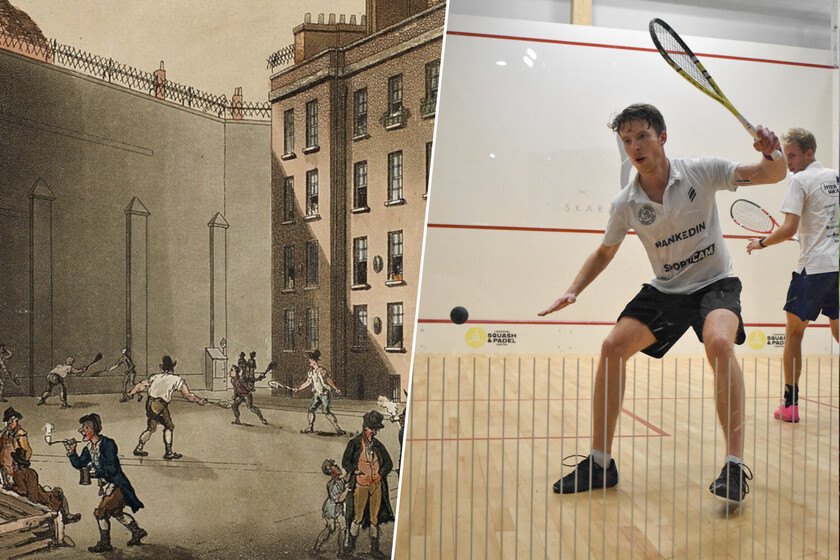
Millions of squash players worldwide are unknowingly indebted to an 18th-century London prison. The sport’s origins can be traced back to the Fleet Prison, where inmates, often imprisoned for debt, developed a game to occupy their time. This pastime, known as “rackets,” eventually evolved and gained sophistication among students at Harrow School, laying the groundwork for modern squash.
The Joy of Striking a Ball
The pleasure of hitting a ball has a long history, predating modern sports. Ancient French children played “jeu de paume” nearly a millennium ago, a game involving hitting leather or cloth balls filled with sawdust against walls. Monks also engaged in similar activities in cloisters, sometimes using branches to strike the balls. Over time, this evolved into tennis, which became popular in Britain, even captivating the Tudors, with King Henry VIII reportedly commissioning courts in his palaces. By 1600, Paris had an estimated 250 courts. The popularity of these games led to various styles and rules, including “fives” and later “racketball.”
Athletes Behind Bars
In the early 18th century, the love for these ball games even reached Fleet Prison. Inmates, seeking to alleviate the tedium of their confinement, created a simplified version of “fives” using readily available materials: a small, cloth-wrapped ball akin to a golf ball and a racket. This game became known as ‘racquets’ or “rackets,” and its simple premise involved players hitting the ball against a wall.
A Special Kind of Prison
Fleet Prison was not an ordinary jail. While its history dated back to the 12th century, the 18th-century inmates were primarily imprisoned for debt or contempt of court, rather than violent crimes. Philanthropist John Howard, in his 1770s treatise ‘The State of Prisons in England and Wales,’ documented life within Fleet, noting that prisoners played various games like bowls, “mississippi,” “fives,” and tennis in the yard, with visitors from local markets sometimes joining in.
The Significance of ‘Racquet’
The game of ‘racquet,’ which thrived in places like Fleet and King’s Bench Prison, soon spread across Great Britain. Far from being associated with its prison origins, it became a popular pastime in taverns and alleyways, with dedicated courts being built. The sport’s popularity grew so significantly that by 1830, the Royal Artillery had constructed an indoor court in Woolwich for soldiers to play, even during inclement weather.
Harrow School’s Influence
Harrow School, a prestigious boarding school founded in the 16th century, became a pivotal location in the evolution of ‘racquet’ and ‘fives.’ It was here that the game that would become squash truly took shape. Students played in the main building’s outdoor courtyard, adapting the rules to their preferences. A key innovation was the substitution of rigid balls with rubber ones. These larger, hollow rubber balls significantly altered the game’s dynamics and pace, paving the way for “squash.”
A Sport with Appeal
Initially, squash was exclusive to Harrow, much like other private schools with their unique sports. However, as students departed for holidays or graduated, they took their passion for squash with them, spreading it throughout the country. Other British schools and organizations soon adopted the game, which had originated in the halls of Harrow and the yards of a former prison.
Fleet’s Role Reassessed
While some scholars, like J.R. Atkins, argue that ‘racquets’ and tennis are too historically intertwined to separate, the majority of accounts acknowledge Fleet Prison’s significant role in the game’s development and popularization. Harrow School is credited with refining the sport and giving it respectability, but the contribution of Fleet’s inmates is recognized by organizations such as World Squash, the University of Oxford, and the IOC.
Ted Wallbutton of the World Squash Federation (WSF) explains that in the early 19th century, the fascination with rackets and balls led to a new variant of the sport emerging in Fleet Prison. “The prisoners of Fleet, mostly debtors, exercised by hitting a ball against the walls, of which there were many, with rackets. Thus began the game of ‘Rackets.’ By some strange path, they brought it to Harrow and other select English schools around 1820, and from there our own sport, squash or squash rackets, developed.”
An Unconventional Connection
While a prison’s connection to a sport might seem unusual, it’s not unique. Pilates, for instance, was developed by Joseph Pilates while he was interned during World War I. Even the polaina and the development of modern treadmills have links to prison environments.
Datos clave
| Aspecto | Detalle |
|——————|————————————————|
| Origen del Juego | Prisión de Fleet, Londres, siglo XVIII |
| Nombre Original | ‘Racquets’ o “rackets” |
| Evolución Final | Harrow School, introducción de pelotas de caucho |
| Deporte Moderno | Squash |
This historical narrative is particularly relevant to our readership as it highlights how innovation and adaptation can emerge from unexpected circumstances. The evolution of squash from a prison pastime to a globally recognized sport underscores the enduring human desire for recreation and the unpredictable paths that cultural developments can take. It’s a reminder that even seemingly niche activities can have profound and lasting impacts.
Fuente: En el mundo hay millones de jugadores de squash. Sin saberlo, tienen una deuda con una cárcel londinense del siglo XVIII, Xataka (https://www.xataka.com/magnet/mundo-hay-millones-jugadores-squash-saberlo-tienen-deuda-carcel-londinense-siglo-xviii)
Datos clave
| Punto | Detalle |
|---|---|
| Fuente | Xataka IA |
| Fecha | 2026-05-31T11:16:44+00:00 |
| Tema | En el mundo hay millones de jugadores de squash. Sin saberlo, tienen una deuda con una cárcel londinense del siglo XVIII |
Source
Xataka IA Publicacion original: 2026-05-31T11:16:44+00:00
Related articles

IBM CEO Puts a Number on the Open-Weight AI Value Proposition: 90% of the Performance at 10% of the Token Cost
IBM CEO Arvind Krishna told analysts that open-weight models now deliver about 90% of frontier-model effectiveness while costing between 10% and 25%…
Read article
OCU Finds Spanish Homeowner Communities Overpaying Up to €1,500 on Electricity and €3,515 on Gas—Can AI Tools Optimize Shared Energy Bills?
A new OCU analysis of Spanish homeowner community bills reveals widespread overpayment due to non-competitive tariffs and excess contracted power. Could AI-driven…
Read article
Mayotte fiber dispute does not meet ReviewArticle’s AI news brief
Le Monde reports that France’s competition authority has ordered Orange to suspend part of its fiber-optic rollout in Mayotte. The dispute is…
Read article
DiffEEG Model Uses Diffusion Pre-Training to Improve Seizure Detection from Minimal Labeled Data
Researchers have introduced DiffEEG, a 9.6-million-parameter foundation model that combines denoising diffusion pre-training with reinforcement learning fine-tuning to detect seizure events from…
Read articleWiki relacionada

AI Model API Pricing and Context Window Comparison: Current Rates and Limits
Compare the latest API pricing, context windows, and capabilities of leading AI model providers including OpenAI, Anthropic, Google, and Mistral. Practical guidance…
Read article
AI Agent Evaluation Frameworks: How to Benchmark Agentic Systems
A practical guide to evaluating AI agents — from task completion metrics to safety, cost, and robustness. Covers major frameworks, primary sources,…
Read article
LLM Benchmarks Decoded: What MMLU, HumanEval, and GSM8K Actually Measure for Developers
A developer-focused breakdown of the most-cited LLM benchmarks — MMLU, HumanEval, GSM8K, MATH, Chatbot Arena — including what they test, their hidden…
Read article
What Is RAG? A Practical Guide to Retrieval-Augmented Generation in 2025
Retrieval-Augmented Generation (RAG) grounds LLM outputs in external data, reducing hallucinations and enabling enterprise use cases. This guide covers how RAG works,…
Read article