
Global Salaries: Purchasing Power Parity Reveals Shifting Economic Landscape
A new visualization by VisualCapitalist, using data from the International Labour Organization (ILO), illustrates global salary disparities adjusted for Purchasing Power Parity (PPP), offering a clearer view of real-world earning potential across nations.
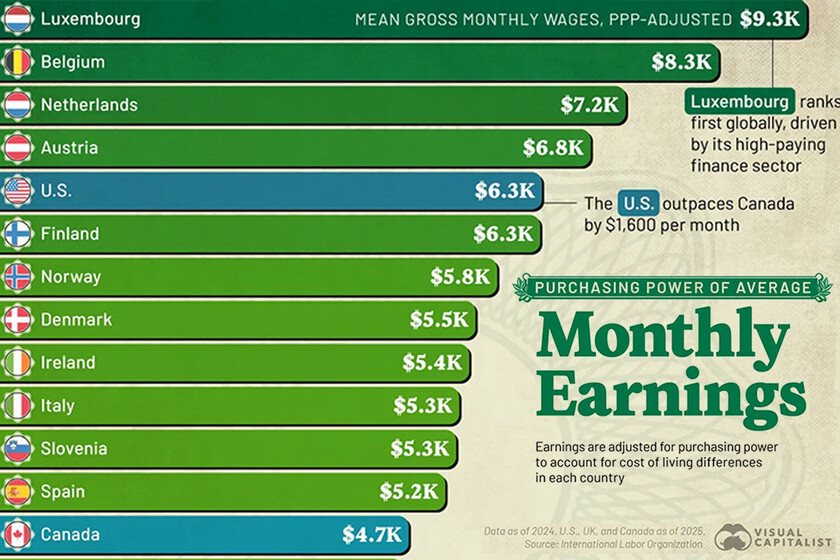
A recent visualization by VisualCapitalist, drawing on data from the International Labour Organization (ILO), presents a compelling look at global salary differences, specifically through the lens of Purchasing Power Parity (PPP). This adjustment offers a more nuanced understanding of how far salaries truly extend in different countries, moving beyond nominal figures to reflect actual living costs and consumption capabilities.
The analysis underscores that a direct comparison of raw salaries can be misleading. The cost of essential goods and services, from housing and food to transportation, varies significantly across borders. PPP aims to standardize these differences, allowing for a more accurate comparison of the purchasing power of an average salary in one nation versus another.
Understanding Purchasing Power Parity
Purchasing Power Parity (PPP) is an economic theory that compares different countries’ currencies through a “basket of goods” approach. It determines the amount of currency needed to purchase the same goods and services in different countries. In the context of salaries, PPP adjustments are crucial for understanding real earning potential.
For instance, a salary that appears substantial in a country with a lower cost of living might offer significantly less purchasing power compared to a seemingly lower salary in a country with a higher cost of living. The ILO data, as visualized by VisualCapitalist, adjusts nominal salaries to reflect this by calculating what an average salary can actually buy within its local economy. This means a higher PPP-adjusted salary indicates that an individual’s earnings can acquire a greater quantity of goods and services in that country. Conversely, a lower PPP-adjusted salary suggests that despite potentially high nominal wages, the cost of living erodes the real value of those earnings.
Luxembourg Leads the Pack
The visualization clearly positions Luxembourg at the forefront of countries where salaries offer the greatest purchasing power. With a PPP-adjusted monthly salary of $9,307, Luxembourg not only boasts high earnings but also the highest minimum wage in Europe. This strong performance indicates a robust economy where salaries are well-aligned with the cost of living.
Following Luxembourg, Belgium ranks second with $8,297 per month, and the Netherlands secures third place with $7,234. Austria follows at fourth with $6,832, and the United States and Finland round out the top six, each with adjusted salaries just under $6,300 per month. The concentration of European nations in the top tier highlights the region’s economic strength in providing salaries that generally keep pace with living expenses.
European economies continue to dominate the upper echelons of the PPP-adjusted salary rankings, suggesting a generally favorable balance between earnings and the cost of goods and services in many of these nations. This alignment is critical for consumer confidence and overall economic stability, as it directly impacts the daily lives and financial well-being of citizens.
Surprises in the Rankings
Switzerland, despite often being perceived as a country with exceptionally high wages, presents a notable surprise in the ranking. Its PPP-adjusted monthly salary stands at $4,683. While nominal wages in Switzerland are indeed among the world’s highest, the country’s correspondingly high cost of living, particularly for housing, services, and consumer goods, significantly diminishes the real purchasing power of these earnings. This positions Switzerland behind countries like Canada and Italy after the PPP adjustment, illustrating that high nominal salaries do not always translate to superior real-world spending power.
The gap between the leading nations and those further down the list is substantial. France, for example, is ranked 25th with a PPP-adjusted salary of $3,064 per month, which is approximately one-third of Luxembourg’s adjusted income. While the average nominal salary in France is around €3,650 per month, the PPP adjustment suggests that the cost of living in France is slightly higher than what salaries can comfortably afford, making it comparatively more expensive than Luxembourg.
Similarly, Poland and Greece appear at the lower end of the analyzed countries, with PPP-adjusted salaries of $3,082 and $3,546 respectively. These figures indicate that workers in these nations face a higher cost of living relative to their earnings, impacting their overall purchasing power.
Spain’s Position
Spain occupies a mid-to-upper position in the rankings, with a PPP-adjusted monthly salary of $5,166. This figure represents approximately 56% of the purchasing power seen in the leading country, Luxembourg. The situation in Spain is somewhat contrary to that of France; the adjusted salary is roughly double the average nominal salary, which, according to the Adecco Salary Monitor 2025, stands at around €2,048 per month.
This suggests that, on average, salaries in Spain provide sufficient purchasing power to cover essential expenses and potentially allow for some savings. The ability to meet basic needs and have discretionary income is a key indicator of economic well-being.
However, the persistent high cost of housing in Spain remains a significant challenge, acting as a considerable drag on the purchasing power of its residents. Despite recent increases in the Minimum Interprofessional Wage (SMI) that have contributed to a rise in the national average salary, the housing market’s affordability issues prevent Spanish salaries from climbing higher in the global PPP-adjusted rankings. This highlights the complex interplay between wage growth, cost of living, and specific market factors like real estate prices in determining a nation’s true economic standing for its citizens.
Key facts
- Metric: Value (USD/month, PPP-adjusted)
- Top Country (Luxembourg): 9,307
- Belgium: 8,297
- Netherlands: 7,234
- Spain: 5,166
- Switzerland: 4,683
The analysis, rooted in ILO data and visualized by VisualCapitalist, provides a critical perspective for understanding global economic health beyond nominal figures. For individuals and businesses alike, a clear grasp of PPP-adjusted salaries is essential for making informed decisions about international employment, cost of living assessments, and broader economic comparisons across different regions. The data serves as a valuable tool for policymakers and researchers aiming to gauge the real economic standing of populations worldwide.
Source: Si la pregunta es en qué país del mundo cunde más el salario, este gráfico tiene la respuesta: en España nos podría ir peor – Xataka: https://www.xataka.com/empresas-y-economia/pregunta-que-pais-mundo-cunde-salario-este-grafico-tiene-respuesta-espana-nos-podria-ir-peor
Source
Xataka IA Publicacion original: 2026-05-23T09:01:34+00:00
Related articles

OCU Finds Spanish Homeowner Communities Overpaying Up to €1,500 on Electricity and €3,515 on Gas—Can AI Tools Optimize Shared Energy Bills?
A new OCU analysis of Spanish homeowner community bills reveals widespread overpayment due to non-competitive tariffs and excess contracted power. Could AI-driven…
Read article
Mayotte fiber dispute does not meet ReviewArticle’s AI news brief
Le Monde reports that France’s competition authority has ordered Orange to suspend part of its fiber-optic rollout in Mayotte. The dispute is…
Read article
DiffEEG Model Uses Diffusion Pre-Training to Improve Seizure Detection from Minimal Labeled Data
Researchers have introduced DiffEEG, a 9.6-million-parameter foundation model that combines denoising diffusion pre-training with reinforcement learning fine-tuning to detect seizure events from…
Read article
The Technology Trap: Why AI Cannot Escape the Unchanging Fundamentals of War
A new Foreign Affairs essay by former Pentagon official Mara Karlin warns that over-reliance on AI and advanced tech in military planning…
Read articleWiki relacionada

AI Model API Pricing and Context Window Comparison: Current Rates and Limits
Compare the latest API pricing, context windows, and capabilities of leading AI model providers including OpenAI, Anthropic, Google, and Mistral. Practical guidance…
Read article
AI Agent Evaluation Frameworks: How to Benchmark Agentic Systems
A practical guide to evaluating AI agents — from task completion metrics to safety, cost, and robustness. Covers major frameworks, primary sources,…
Read article
LLM Benchmarks Decoded: What MMLU, HumanEval, and GSM8K Actually Measure for Developers
A developer-focused breakdown of the most-cited LLM benchmarks — MMLU, HumanEval, GSM8K, MATH, Chatbot Arena — including what they test, their hidden…
Read article
What Is RAG? A Practical Guide to Retrieval-Augmented Generation in 2025
Retrieval-Augmented Generation (RAG) grounds LLM outputs in external data, reducing hallucinations and enabling enterprise use cases. This guide covers how RAG works,…
Read article